
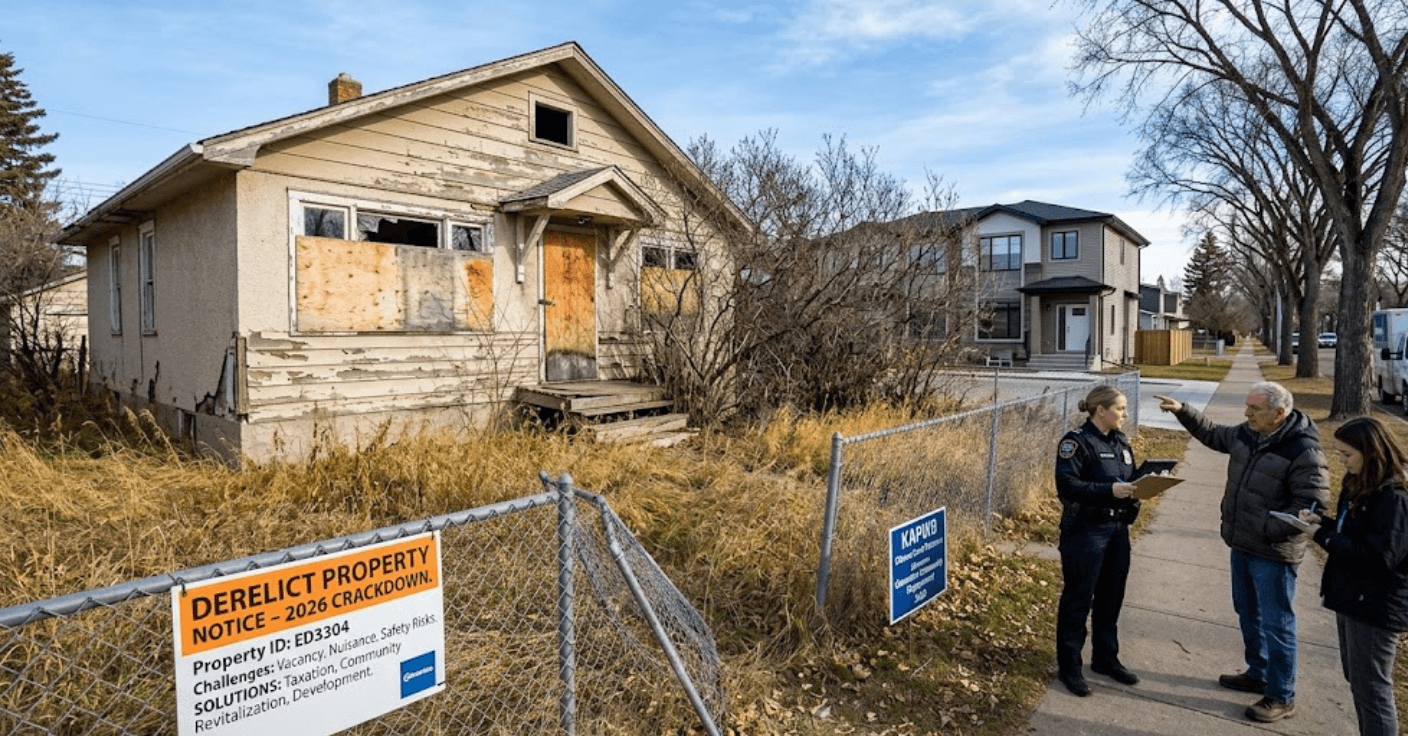
Derelict Property Challenges and Solutions in Edmonton, Alberta
Addressing commercial property vacancy and the role of punitive property tax
Edmonton is intensifying efforts to address the persistent issue of derelict properties within its mature neighborhoods.
In September 2023, the city council approved a new tax subclass targeting residential properties that are uninhabitable or in significant disrepair.
This initiative imposes a property tax rate approximately three times higher than that of standard residential properties, aiming to motivate owners to rehabilitate or redevelop their neglected assets.
By May 2024, this approach had already yielded positive results, with over 15% of the initially identified 300 derelict properties undergoing restoration efforts.
To further encourage property owners, the city introduced a prorated tax forgiveness program in October 2024.
This program offers tax incentives to owners who clean up their derelict properties, providing refunds for the portion of the year during which the property was no longer in a derelict state.
For instance, if a derelict home is demolished in May, the owner would pay the higher tax rate up to that point and receive a refund for the remainder of the year, effectively paying the standard residential rate post-demolition.
Building on these measures, the city expanded the derelict residential tax subclass city-wide in 2026.
This expansion required additional resources to identify and assess derelict properties beyond mature areas, ensuring a comprehensive approach to revitalizing neighborhoods across Edmonton.
The program's success is evident, with 30% of properties assessed as derelict in 2024 having been demolished by the following year.
Furthermore, 24% of these properties were sold within the same period, indicating a significant shift towards redevelopment and community improvement.
While the focus has been primarily on residential properties, the city is now turning its attention to commercial property vacancies.
In January 2026, a fire at an abandoned commercial building adjacent to a local music venue reignited concerns about the impact of vacant commercial properties on community safety and vibrancy.
Local business owners have expressed frustration over long-standing issues with neighboring derelict properties, emphasizing the need for policy changes to encourage business development and neighborhood revitalization.
In response, the city is exploring the implementation of a punitive property tax for commercial properties left vacant or in disrepair.
This approach mirrors the successful residential tax subclass and aims to incentivize owners to maintain and utilize their commercial properties actively.
However, legal and logistical challenges remain before such measures can be enforced.
Despite these challenges, Edmonton's retail market has shown resilience.
Reports from October 2025 indicate that the city's retail sector continues to perform well, driven by rising incomes and population growth.
Edmonton leads Canada in per capita retail expenditures, bolstered by well-paying jobs in the energy sector and a favorable housing affordability index.
As the city continues to tackle the issue of derelict properties, the combination of punitive tax measures and incentives for property owners is expected to foster a more vibrant and safe urban environment.
By addressing both residential and commercial vacancies, Edmonton aims to enhance community well-being and stimulate economic growth. |

Sep 13, 2026
Carbon Capture Storage Hub Services in Edmonton, Alberta | CCS Hub Canada
Explore Alberta's expanding carbon capture storage hub network, from Edmonton's Wabamun project to the Origins CCS hub — Canada's largest CCS facility.

Sep 10, 2026
Meta AI Data Centre Coming to Edmonton Alberta | Sturgeon County Project
Meta AI data centre in Sturgeon County is reshaping Edmonton Alberta's economy with 3,000+ jobs and a $13B investment in Canada's AI future.

Sep 7, 2026
Shop Local in Edmonton: Supporting Local Businesses for a Thriving Community
Discover how Edmonton's shop local movement boosts local business support and small business growth for a resilient community.

Sep 2, 2026
International School Trips in Edmonton: EPSB Cancels Overseas Travel
Edmonton public schools announce school trip cancellations for international school trips, impacting students and teachers across the district.
0 Comments
Join the conversation
Be the first to comment
Share your thoughts above.