
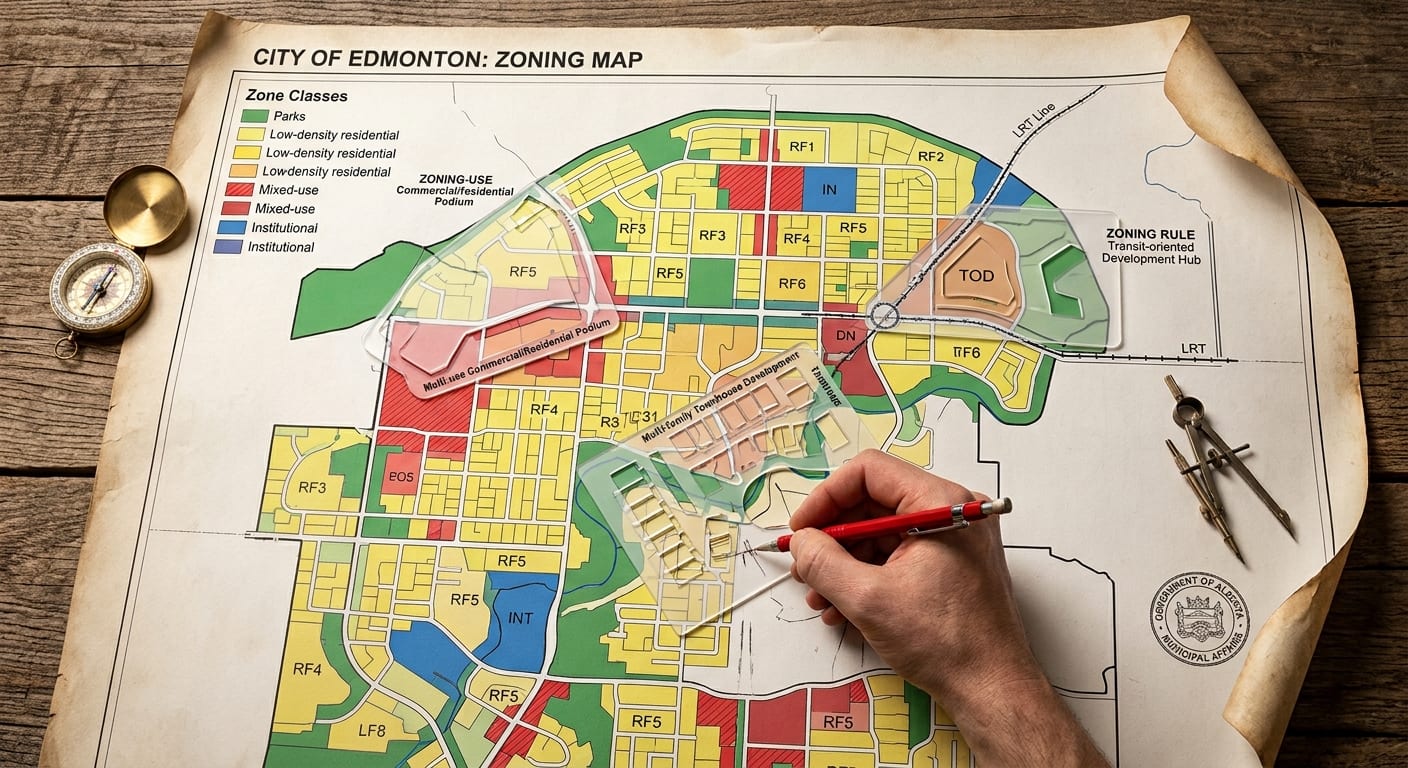
Province Orders Edmonton to Revert to Its Old Zoning Bylaw
How the province's zoning bylaw rollback affects minimum parking requirements across the city
Something significant is happening to the way Edmonton is allowed to grow — and not everyone is happy about it.
The Alberta government has issued a directive ordering Edmonton to reverse years of progressive land-use reform, sending the city's planning ambitions into reverse gear and reigniting a fierce debate about who really controls local neighbourhoods.
At the heart of the controversy is the Edmonton zoning bylaw — a landmark document that reshaped how the city thinks about housing, density, and parking — and what happens now that the province has moved to dismantle key parts of it.
Premier Danielle Smith announced the sweeping directive on October 8th, giving Edmonton City Council three months to comply — a deadline that lands in early January.
The order demands that the city revert its land-use rules to the parameters that were in place before its 2024 zoning overhaul, covering everything from housing types and building heights to density allowances in established residential neighbourhoods.
But one piece of the rollback is drawing particular attention from developers, urban planners, and everyday Edmontonians alike: the reinstatement of minimum parking requirements.
Edmonton made history back in 2020 when it became the first major Canadian city to scrap minimum parking requirements entirely, giving builders and homeowners the freedom to determine how much on-site parking their projects actually needed, rather than being forced to meet an arbitrary government-mandated number of stalls per unit.
It was a bold, forward-looking move — one that earned the city national recognition and aligned squarely with broader efforts to reduce car dependency, lower construction costs, and make infill housing more financially viable across established neighbourhoods.
Now, under the revised Alberta zoning rules, those requirements are coming back — and with them, a cost burden that housing advocates argue will quietly price out exactly the kinds of projects Edmonton needs most.
The province argues the changes are a response to legitimate concerns from residents who say rapid infill development has altered the character of their communities in ways they never expected.
Pointing to multifamily complexes rising in neighbourhoods previously defined by single-family homes, provincial officials have framed the rollback as a matter of balance and thoughtful community integration rather than outright opposition to density.
Critics, however, say the framing doesn't hold up under scrutiny.
Edmonton's 2024 zoning bylaw — the product of the city's first comprehensive zoning rewrite in generations — didn't arrive out of nowhere.
It was the result of years of public consultation, deep planning expertise, and deliberate policy evolution stretching back many decades.
Since taking effect at the start of 2024, the bylaw drove a record number of housing starts across the city, and permitted more than five thousand multiplexes in mature neighbourhoods — representing a meaningful share of all new homes approved during that period.
Those are not abstract statistics — they are the direct output of a policy designed with Edmonton's future housing needs in mind.
They represent families who found housing options they could actually afford, builders who placed real investment into Edmonton's established areas, and streets that gradually began to resemble the kind of mixed, walkable communities that urban planners, transit advocates, and housing researchers have long argued are healthier, more equitable, and more economically sustainable over the long term.
Mayor Andrew Knack did not mince words in response to the provincial directive, calling it chaotic and uninformed and warning that it will drive up property taxes, reduce housing affordability, and chill investment attraction across the city.
The mayor expressed genuine surprise at the move, noting that responsible governance requires a degree of respect for decisions made at the municipal level by elected representatives who know their communities best.
The implications extend far beyond city hall politics, planning charts, and ideological disagreements about density.
Edmonton had secured significant federal funding — more than two hundred million dollars — tied directly to its commitment to accelerate housing supply through progressive zoning reform and streamlined approvals.
Rolling back the very rules that unlocked that funding creates real uncertainty about whether the city can continue to access it, adding a serious financial dimension to what is already a politically charged standoff between two levels of government.
The risk of losing that federal investment isn't hypothetical — it is a consequence that could ripple through city budgets and housing pipelines for years to come.
The reinstatement of minimum parking requirements deserves particular scrutiny, because it touches directly on the economics of building homes in Edmonton's older, established neighbourhoods.
When a developer is required by law to include a set number of parking stalls per unit — regardless of whether future residents want or need them — the cost of that parking gets baked into the price of every home in the building.
In neighbourhoods well-served by transit or situated close to shops, schools, and daily amenities, mandatory parking can make otherwise viable infill projects financially unworkable, effectively acting as a quiet and overlooked tax on density.
Edmonton's original decision to eliminate those requirements in 2020 was widely praised by housing advocates and urban economists, who argued it removed one of the most persistent and underappreciated structural barriers to affordable infill development.
Bringing those requirements back doesn't just reverse a policy — it signals a fundamental retreat from the direction Edmonton had been deliberately and carefully charting for itself.
Alberta Municipalities, the provincial body representing more than two hundred and sixty municipalities across the province, has also weighed in — calling on the province to rescind the order entirely.
That level of broad institutional pushback suggests the concern isn't confined to Edmonton's council chambers or a handful of vocal urban planning advocates.
Even Calgary's mayor took the unusual step of voicing opposition, arguing that the province's intervention sets a troubling precedent for how the relationship between provincial authority and municipal self-determination is managed going forward.
For the Edmontonians watching this unfold from their front porches and kitchen tables, the stakes are deeply personal, immediate, and in some cases financially significant.
Residents in mature neighbourhoods who supported densification as a way to bring life, affordability, and new neighbours into aging communities now face real uncertainty about projects they may have been counting on.
Builders who carefully planned and financed developments under the existing rules are now navigating a suddenly shifting regulatory landscape, and some are reportedly pausing — or walking away entirely — to reassess whether their projects still make financial sense under a reverted bylaw framework that adds new cost requirements they hadn't budgeted for.
The city now faces an eighteen-month review process as well — a period during which Edmonton must comprehensively reassess its broader approach to land-use planning and infill development, with meaningful public consultation required at every stage.
That review could ultimately chart a path back toward something resembling the city's current progressive direction, or it could entrench the rollback more permanently, depending on how the political and community climate evolves over the coming year and a half.
What's clear in the meantime is that the fight over the Edmonton zoning bylaw is as much a fight about values as it is about parking stalls or building heights.
It's a fight about who gets to decide what a city looks like, who gets to live in it, and whether affordability and neighbourhood character are genuinely in conflict — or whether that tension has been manufactured as political cover for something else entirely.
Edmonton spent years building toward a more inclusive, flexible, and housing-forward version of itself, crafting policy with genuine community input and national recognition to show for it.
Whether that vision survives this provincial intervention — or gets quietly buried under layers of top-down override — may be one of the most consequential urban planning questions facing the city in a generation. |

Oct 8, 2026
Electricity Franchise Fee Increase Coming to Edmonton — What It Means for Your Power Bill
Edmonton council voted 8-5 to raise the electricity franchise fee from 17.65% to 19.4%. Here's what the EPCOR franchise fee hike means for your power bill.

Oct 4, 2026
Transit App Free Features Now Available in Edmonton Alberta | ETS Upgrade
Explore transit app free features now unlocked for all Edmonton riders. Discover the latest Edmonton transit app upgrades and public transit improvements.

Sep 30, 2026
Pre-Treatment Beds for Addiction Recovery in Edmonton, Alberta
Edmonton's new pre-treatment beds addiction program expands addiction recovery beds with targeted treatment funding across Alberta's recovery system.

Sep 27, 2026
Driving Safety Training Campus Coming to Edmonton, Alberta
A new driving safety training campus is coming to Beaumont, backed by $38.5M in provincial funding infrastructure to serve the greater Edmonton region.
0 Comments
Join the conversation
Be the first to comment
Share your thoughts above.