
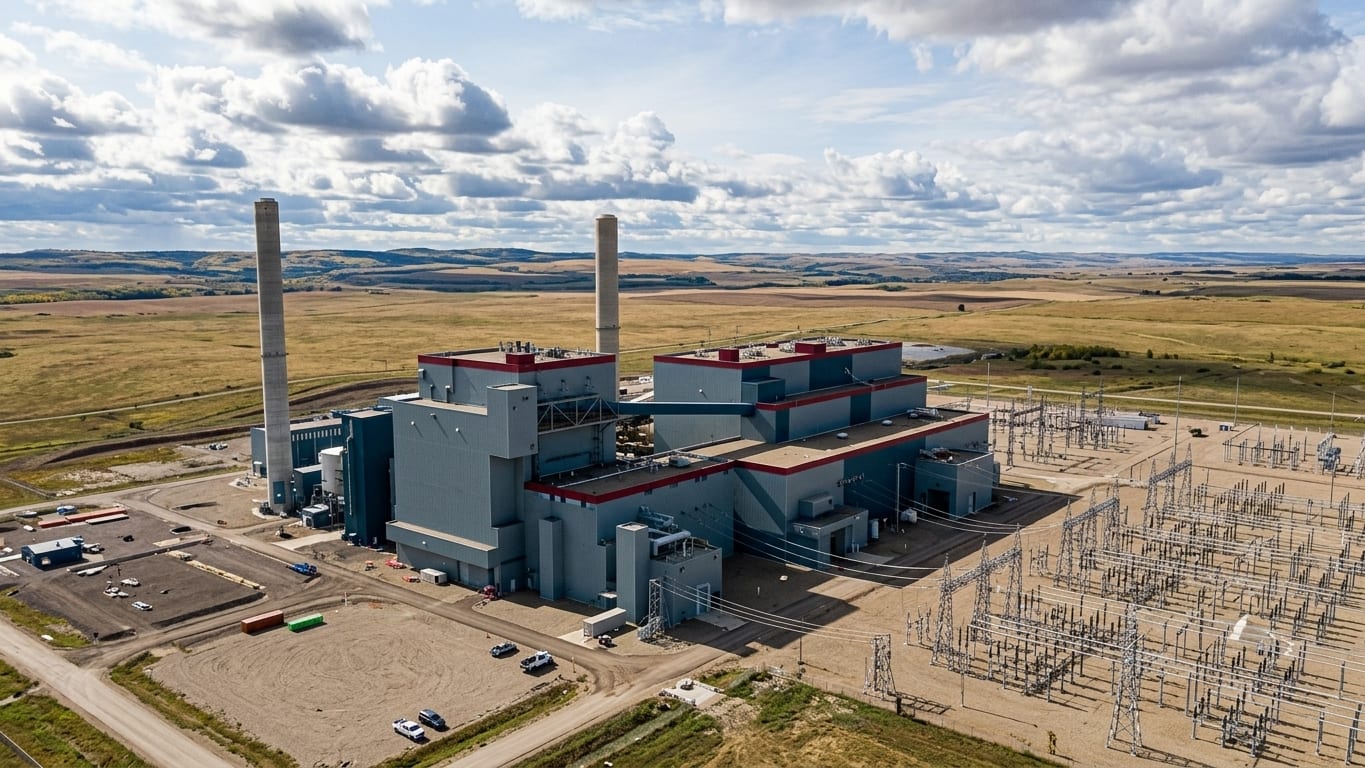
Central Alberta Carbon Capture Hub on Track to Be Largest in Canada
Exploring Canada's growing CCS hub landscape and Alberta's carbon capture initiatives
Alberta is rewriting its energy identity — and at the center of that transformation is a rapidly expanding network of carbon capture storage hub projects that are putting the province on the map as a global leader in emissions reduction.
From the rolling farmland near Clive to the industrial corridors ringing Edmonton, the infrastructure being built today is setting the stage for a dramatically different emissions landscape across Western Canada.
The story begins, in many ways, just south of Edmonton — roughly 140 kilometres away, in the small central Alberta village of Clive, where the Origins Carbon Capture and Storage Hub has officially broken ground.
The project is not a modest experiment.
Once commercial operations begin in January 2027, the Origins CCS Hub is expected to become the single largest carbon capture and storage facility in Canada — and one of the largest on the planet.
The facility, developed by Enhance Energy, will initially have the capacity to permanently store up to 1.5 million metric tonnes of carbon dioxide annually — an amount roughly equivalent to removing more than 500,000 cars from Canadian roads every single year.
Enhance Energy has operated a CCS project in Clive for over five years and has already permanently sequestered more than seven million tonnes of industrial CO2 emissions from Alberta's energy sector — a track record that gave regulators enough confidence to grant full regulatory approval for the Origins saline aquifer project.
The company also serves as a founding partner of the Alberta Carbon Trunk Line, a 1.2-billion-dollar CO2 transportation system connecting industrial emitters in the Edmonton region to deep underground storage near Clive.
The Origins Hub marks a turning point — not just for one company, but for the entire trajectory of Canada's carbon management strategy.
Federal and provincial officials attended the groundbreaking ceremony together, signaling a rare show of unified ambition across government levels at a time when climate policy has often divided Ottawa and Alberta.
Federal energy and natural resources officials characterized the project as a milestone in Canada's push to become an environmentally responsible energy superpower — capable of producing hydrocarbons while simultaneously building world-class systems to manage the emissions that come with them.
That dual identity — energy producer and climate innovator — is increasingly the brand that Alberta is working to project to international markets, investors, and trading partners.
But the Origins Hub is far from the only story driving the CCS hub Canada conversation.
Around Edmonton, a constellation of major carbon sequestration projects is taking shape, each targeting different industrial emitters and underground storage formations across the region.
West of the capital, the Open Access Wabamun Carbon Hub is advancing plans to build a scalable CO2 transportation and storage network designed to serve multiple industrial facilities simultaneously.
What makes the Wabamun Hub particularly notable is its community dimension: five nearby Indigenous communities have been given the opportunity to co-own the hub's CO2 transportation and storage infrastructure — a model that local leaders say could become a blueprint for inclusive energy transition across the country.
That kind of partnership, critics and supporters alike acknowledge, is rare in Canadian energy infrastructure development.
North of Edmonton, the Meadowbrook Hub Project is advancing its own sequestration ambitions, while northeast of the city, a joint venture between two of Canada's largest pipeline operators is developing the Alberta Carbon Grid — a project that could serve as a backbone for regional emissions transport for decades to come.
East of Edmonton, the Atlas Carbon Storage Hub adds yet another node to what is quickly becoming one of the most ambitious carbon infrastructure corridors in the world.
Taken together, these projects represent a fundamental reimagining of how Alberta — and Canada — will manage industrial emissions during the long transition to a lower-carbon economy.
According to recent reports, Alberta's government has issued multiple calls for carbon sequestration tenure proposals across the province, pushing open-access hub models that separate CO2 capture, transportation, and storage into distinct, interoperable services.
The open-access model is widely regarded as a game-changer for smaller industrial emitters who previously couldn't afford to build their own capture and storage infrastructure from scratch.
By plugging into a shared network — much like connecting to a highway rather than building a private road — refineries, cement plants, hydrogen producers, and power generators can dramatically cut the cost of meeting federal and provincial emissions targets.
In Edmonton specifically, this model is already showing results, with major industrial facilities connecting to CO2 transport lines and routing captured emissions directly into the Alberta Carbon Trunk Line system for permanent underground storage.
The scale of investment flowing into Edmonton and the surrounding region is difficult to overstate.
Federal officials recently announced more than $21.5 million in new funding directed toward advancing carbon capture and storage technologies across Alberta — supporting everything from deep saline reservoir characterization to CO2 compression systems at smaller industrial sites.
That investment is expected to catalyze hundreds of millions more in private capital, with the Origins Hub alone projected to bring between $200 million and $400 million in direct regional investment before reaching full capacity.
The Origins Hub has also been designed with expansion in mind — meaning the 1.5 million tonne annual figure cited at groundbreaking could grow substantially as more industrial partners connect and additional storage formations come online.
Not everyone has welcomed the pace of development without reservation.
Agricultural organizations have raised concerns about the potential for CO2 storage wells to interact with groundwater systems, citing cases internationally where similar risks prompted regulatory intervention.
Project proponents maintain that Alberta's geology, regulatory framework, and decades of operational experience with underground injection make the province uniquely positioned to manage these risks responsibly.
Enhance Energy has pointed to its own long operational record in Clive as evidence that large-scale CO2 sequestration can be managed safely over extended timeframes — a track record that regulators and independent researchers have scrutinized carefully.
Globally, more than 100 CCS hubs are now in development, according to recent industry data — a figure that reflects how rapidly carbon capture has moved from niche technology to mainstream industrial strategy.
Alberta already punches well above its weight in this space, with the Alberta Carbon Trunk Line cited internationally as a commercial-scale model for shared CO2 transportation infrastructure.
For Edmonton, the stakes are both environmental and economic.
Residents say the shift to a lower-emissions industrial base isn't only about meeting climate targets — it's about the long-term competitiveness of Alberta's energy sector in a world where trading partners are scrutinizing the carbon intensity of the products they buy.
Edmonton's position at the hub of a regional CCS network gives the city a structural advantage that officials believe will attract clean technology investment, skilled trades employment, and new industrial partnerships for years to come.
Carbon Capture Canada, the country's national convention on carbon capture and storage, is set to return to Edmonton in 2026 — a further sign that the city is cementing its reputation as the commercial capital of the carbon capture Alberta movement.
As shovels break ground near Clive and planning tables fill with blueprints stretching from Wabamun to Meadowbrook to the Atlas corridor, one reality is becoming impossible to ignore: Alberta is not waiting for the future of carbon management to arrive. It is building that future, one hub at a time. |

Sep 10, 2026
Meta AI Data Centre Coming to Edmonton Alberta | Sturgeon County Project
Meta AI data centre in Sturgeon County is reshaping Edmonton Alberta's economy with 3,000+ jobs and a $13B investment in Canada's AI future.

Sep 7, 2026
Shop Local in Edmonton: Supporting Local Businesses for a Thriving Community
Discover how Edmonton's shop local movement boosts local business support and small business growth for a resilient community.

Sep 2, 2026
International School Trips in Edmonton: EPSB Cancels Overseas Travel
Edmonton public schools announce school trip cancellations for international school trips, impacting students and teachers across the district.
Aug 31, 2026
AI Data Centers Stir Debate in Edmonton, Alberta
AI data centers spark heated debate at Edmonton area town halls, as residents discuss the impact of Meta AI campus and data center town hall meetings.
0 Comments
Join the conversation
Be the first to comment
Share your thoughts above.