
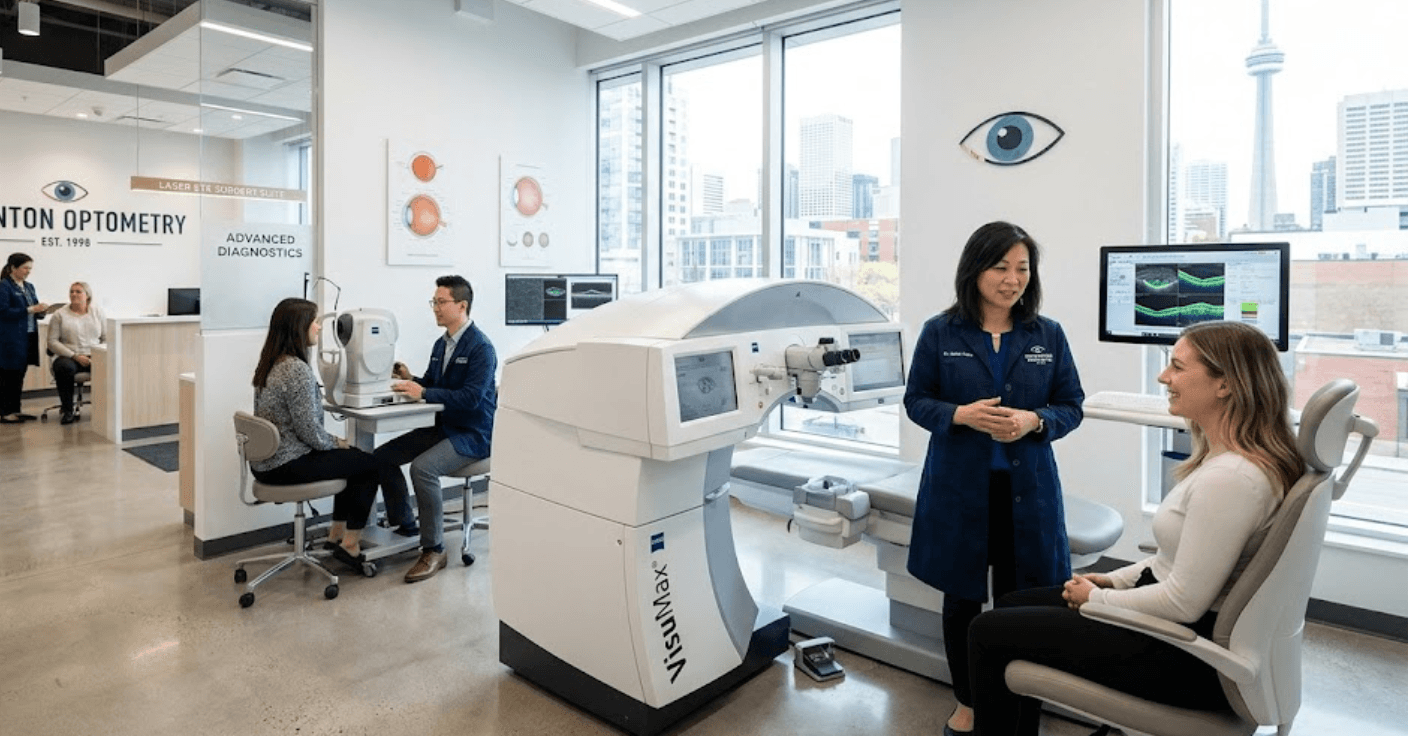
Alberta is set to become the first Canadian province allowing qualified optometrists to perform select minor surgical and laser procedures in-clinic
Offering laser eye procedures and minor eye surgery right in your local clinic
Something significant is happening in eye care across Alberta, and Edmonton residents are poised to feel it first.
For the first time in Canadian history, qualified optometrists will be authorized to perform select optometrist surgical procedures and laser treatments directly inside their community clinics — no hospital referral, no lengthy specialist waitlist, no cross-city commute just to treat a manageable eye condition.
It is a milestone that eye care advocates have been pushing for years, and the change is now officially on the books.
Starting in November 2026, Alberta becomes the first province in Canada to allow Doctors of Optometry who have received specialized training and individual authorization to carry out certain minor surgical and laser procedures inside their own offices.
For patients in a city like Edmonton, where growing demand on the healthcare system has left many waiting far too long for routine eye treatments, the announcement represents a real and tangible shift in how care will be delivered.
The procedures being greenlit for optometrists are not trivial additions to their toolkit.
They include the removal of benign skin lesions around the eyes, treatment of styes, peripheral iridotomy, selective laser trabeculoplasty — a well-established approach for managing glaucoma — and Nd:YAG capsulotomy, which is used to address clouding that can develop after cataract surgery.
Taken together, these are procedures that, until now, required patients to be referred out to ophthalmologists, adding unnecessary steps, delays, and often considerable inconvenience to what should have been a straightforward care pathway.
The burden of that system has fallen most heavily on Albertans living in rural and remote areas, where specialist access is sparse and waiting times stretch on for months.
With over 950 optometrists currently practising across Alberta, the expanded scope creates an immediate and distributed network of care providers capable of delivering these treatments closer to where patients actually live.
In a province as geographically vast as Alberta, that matters enormously.
In Edmonton specifically, the rollout of optometrist surgical procedures in local clinics is expected to ease the strain that has long accumulated at tertiary eye care centres and hospital outpatient departments.
Ophthalmologists, freed from handling cases that optometrists can now safely manage, will be better positioned to dedicate their expertise to the more complex and higher-acuity patients who genuinely require that level of specialty care.
This is not a downgrade in care — it is a smarter redistribution of it.
The Alberta College of Optometrists has been clear that the path to performing these procedures is not a rubber stamp.
Each optometrist seeking authorization must complete dedicated examinations, undergo supervised practice, complete approved training programs, and earn individual certification before offering any of the newly permitted services to patients.
The standards being applied are rigorous by design, ensuring that expanded access never comes at the cost of patient safety.
Doctors of Optometry, it is worth remembering, complete between seven and eight years of education — including a doctoral-level program and clinical clerkships — before they ever see a patient independently.
These are not general practitioners being handed a laser.
They are highly trained eye care specialists whose scope, until now, simply had not kept pace with what their education had already prepared them to do.
The regulatory changes are part of a broader provincial push to modernize Alberta's primary health care system and reduce the surgical and procedural backlogs that have dogged the province in recent years.
Optometrists now join nurse practitioners and pharmacists as allied health professionals whose expanded roles are being formally recognized through updated legislation and regulation.
According to officials, the goal is to ensure that Albertans can access the right care, from the right provider, in the right setting — without being forced to navigate a system that routes straightforward cases through unnecessarily complex channels.
For patients in Edmonton interested in laser eye procedures, the implications are particularly promising.
Conditions like glaucoma — which requires careful, ongoing management and often benefits from laser intervention — can now be treated with greater speed and convenience at the community level.
Rather than waiting for an ophthalmologist's calendar to open up, eligible patients may soon be able to walk into a familiar, local optometry clinic and receive the same laser treatment in a fraction of the time.
When it comes to eye conditions like glaucoma, time genuinely matters.
Delays in treatment can translate directly into vision loss that cannot be recovered, making faster access to laser eye procedures not just a matter of convenience, but of real clinical urgency.
On the minor surgical side, procedures like eyelid lesion removal and stye treatment — which previously required referrals, additional appointments, and sometimes considerable waiting — can now be handled in the same clinic where a patient already receives their routine eye exams.
The continuity that creates is meaningful for patients and for the broader efficiency of the healthcare system.
Edmonton's optometry community has long operated as a trusted front line of eye health for hundreds of thousands of residents.
Clinics across the city see patients at every stage of life, from children receiving their first eye exams to seniors managing age-related vision changes.
Local optometrists have the relationships, the patient history, and the clinical context to provide these newly authorized treatments in a way that is deeply integrated with each person's overall care picture.
That kind of continuity is something that a specialist seen once or twice a year simply cannot replicate.
The scope expansion also sends a broader message about how Alberta views the future of its healthcare workforce.
Rather than continuing to funnel patients through a system designed around hospital-based specialist care, the province is deliberately investing in community-level capacity — acknowledging that a well-trained provider in a local clinic can deliver excellent outcomes for the right cases.
It is a model that patient advocates, professional associations, and health system planners have been calling for across multiple disciplines, and Alberta's move in optometry may well set a precedent that other provinces choose to follow.
For Edmonton residents considering their eye care options, the practical takeaway is straightforward: starting November 2026, the scope of what your local optometrist can offer you is growing in meaningful ways.
Whether you have been waiting on a referral for a minor procedure, managing a chronic condition like glaucoma, or simply want the convenience of handling more of your eye health needs in one trusted, familiar place, the door is opening wider.
Alberta has made it official, and Edmonton's clinics are preparing to deliver. |

Oct 26, 2026
Residential Street Parking Rules in Edmonton, Alberta | What Residents Must Know
Residential street parking in Edmonton is changing. Learn the latest parking rules for residents and street parking regulations shaping your neighbourhood.

Oct 21, 2026
Edmonton City Budget 2025: What Residents Need to Know About the Draft Four-Year Budget
Edmonton city budget 2025 explained: draft four-year budget drops Nov. 2, hearings begin Nov. 23, and Edmonton electricity rates rise in 2027.

Oct 19, 2026
Fatal Motorcycle Crash in Edmonton Sparks Push for Traffic Safety
A fatal motorcycle crash in Edmonton reignites calls for traffic safety measures as excessive speeding claims a life and injures a baby at a bus shelter.

Oct 15, 2026
Deep Tech Foundry for Startups in Edmonton, Alberta
Edmonton's new deep tech foundry startup program helps science founders advance research commercialization into scalable companies.
0 Comments
Join the conversation
Be the first to comment
Share your thoughts above.