
Pedal to the Metal: Alberta's First-Ever 120 km/h Highway Opens South of Leduc
The Highway 2 speed limit increase marks a historic Alberta highway speed increase for drivers heading south
Something genuinely historic happened along the Queen Elizabeth II Highway on April 29, 2026 — and if you were heading south out of the Edmonton area that morning, you may have witnessed the moment yourself.
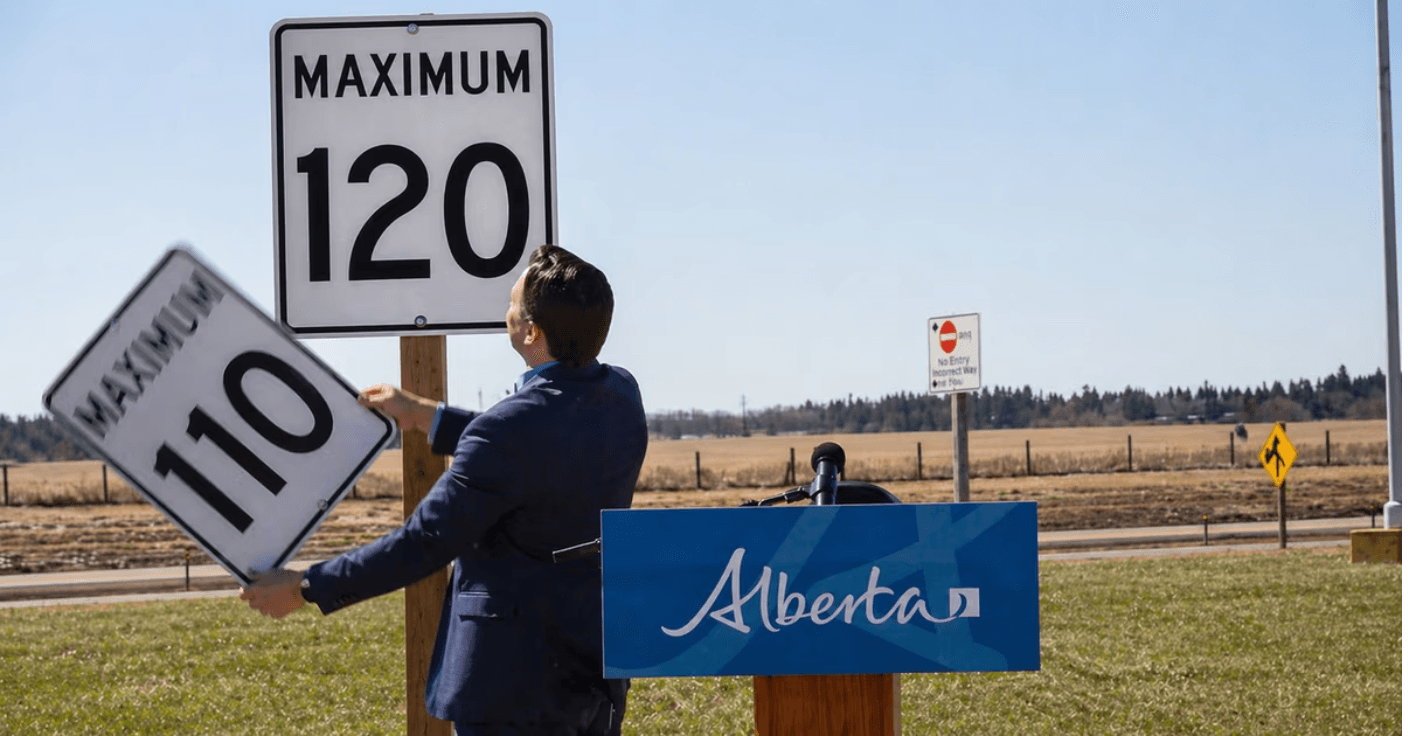
For the first time ever, a posted speed limit sign on an Alberta highway read 120 km/h.
The 120 km/h speed limit Alberta drivers had long discussed, debated, and frankly already practiced on their own terms is now officially on the books — at least on a 22-kilometre stretch of Highway 2 south of the Leduc Commercial Vehicle Inspection Station, running in both directions.
It is a milestone that many Albertans who commute this corridor every day will greet with something between quiet satisfaction and a knowing shrug — because to be honest, plenty of them have been travelling at that speed for years without any legal backing to do so.
The pilot program, launched by the provincial transportation ministry, marks the opening phase of what officials are framing as a broader, data-driven effort to modernize speed regulations on rural divided highways across the province.
Whether it becomes permanent depends entirely on what the numbers reveal by summer's end.
The trial is scheduled to run through the end of summer 2026, with monitoring equipment already embedded in the roadway to track traffic flow, driver behaviour, and safety outcomes — not only within the 22-kilometre pilot zone itself, but also through a five-kilometre buffer corridor extending on either side of the zone's boundaries.
Speed sensors are in the ground, new signage went up on the morning of the launch, and RCMP officers alongside provincial sheriffs were already on active patrol by the time the first commuters rolled through the newly marked stretch.
This is not a soft rollout or a symbolic gesture — the province is watching closely, and so is the rest of the country.
The Highway 2 speed limit change doesn't just rewrite Alberta's rulebook — it ties the province with British Columbia's Coquihalla Highway for the highest posted speed limit anywhere in Canada.
That's a distinction worth pausing on, and one that transportation advocates and safety critics alike have been quick to seize upon in the days since the pilot went live.
The provincial government didn't arrive at this decision arbitrarily or without public input.
A survey conducted in late fall 2025 found that nearly 70 per cent of respondents supported raising speed limits on rural divided highways to 120 km/h — a figure that officials say gave them the public mandate needed to move forward with the pilot in good conscience.
The Transportation and Economic Corridors Minister made clear at the launch event that the intent was not to throw caution aside, but to bring posted limits into alignment with the infrastructure that was designed and built to accommodate exactly this speed from the beginning.
Alberta's divided rural highways, officials explained, were originally engineered with 120 km/h travel in mind — meaning the longstanding 110 km/h limit has functioned as little more than a legal technicality that vast numbers of drivers quietly disregarded on a daily basis.
The pilot, in a sense, is the government finally catching up to the road itself — and to the Albertans who have been driving it for decades.
The stretch of Highway 2 chosen for this trial was selected deliberately and carefully.
This section of the QEII is among the busiest highway corridors in the entire province, carrying a massive daily volume of both personal and commercial traffic between the Edmonton region and communities stretching southward toward Calgary.
Critically, a series of infrastructure improvements had already been completed along this exact corridor before the pilot launched — including extended acceleration and deceleration lanes at overpasses and key intersections in both Leduc County and the County of Wetaskiwin.
Those physical upgrades were cited as a primary reason this particular stretch was selected for the trial, giving engineers and planners confidence that the road itself could safely support the speeds the new signs now permit.
Leduc County leadership voiced strong support for the move, with local officials pointing to those same infrastructure improvements as proof that the region had been genuinely prepared for this change — and expressing real enthusiasm about the quality of data the trial is expected to produce over the coming months.
Area representation at the provincial level echoed that enthusiasm, with the local MLA emphasizing that the pilot reflects the actual rhythms of how Albertans live and move — whether commuting to the city, hauling freight along one of the province's most vital economic corridors, or making the familiar southbound drive with family in tow.
That framing — of the Alberta highway speed increase as fundamentally a question of respecting Albertans' time — has anchored the government's messaging on this initiative since its earliest stages.
The argument is straightforward: if the road was built for 120 km/h, if the majority of drivers are already travelling at or beyond that speed regardless of the posted limit, and if the infrastructure has been upgraded to match, then the previous limit was a formality rather than a meaningful safety threshold.
Not everyone accepts that reasoning.
Safety advocates and members of the first-responder community have raised concerns that are difficult to dismiss, particularly given recent collision trends on this very highway and across the broader Edmonton region.
The preceding year saw a record number of fatal collisions in the Edmonton area, with speed identified as a consistent contributing factor — a trend that critics say worsened after the provincial government moved to eliminate photo radar enforcement province-wide.
Some in emergency response have stated plainly that fatal collisions on Highway 2 are already a recurring reality, and that elevating the posted limit will increase that toll rather than hold it steady.
It is a sobering counterpoint to the government's optimism, and one the pilot data will either confirm or put to rest.
The province, to its credit, appears to have anticipated the safety debate and moved proactively to address it alongside the speed limit change itself.
Running parallel to the pilot is a meaningful tightening of penalties for dangerous driving behaviours across Alberta roads.
Fines for serious offences — including careless driving, excessive speeding, stunting, and street racing — have been increased by 50 per cent, while most other traffic violations have seen a 30 per cent fine increase.
The signal is unmistakable: responsible drivers gain more freedom on open highway, while those who push recklessly past even the new limits will face real and significantly steeper financial consequences.
More speed on the highway, in other words, comes paired with far higher accountability for those who choose to abuse it.
Industry voices have added important nuance to what might otherwise collapse into a simple back-and-forth between speed enthusiasts and safety advocates.
Representatives from road infrastructure associations have noted publicly that any meaningful speed limit increase must be anchored in genuine infrastructure improvements, sustained enforcement presence, and effective public awareness — not simply new signage and an updated fine schedule.
That perspective carries weight, and it deserves to remain part of the conversation as the province evaluates whether this pilot has legs well beyond its initial summer run.
For the thousands of drivers who use this corridor every single day — truckers moving goods between Edmonton and Calgary, Leduc County commuters heading into the city, and families travelling south for the weekend — the change is immediate and tangible.
The sign on that 22-kilometre stretch now reads 120 km/h, and for the first time in Alberta's history, travelling at that pace on a provincial highway is not just common practice — it is the legal standard.
What happens next will matter far beyond this single corridor south of Leduc.
Officials have been clear that if the pilot generates favourable safety and traffic data, the 120 km/h speed limit Alberta experiment will not end with Highway 2 — it could be extended to other rural divided highways across the province, fundamentally reimagining how Alberta manages speed across its broader open-road network.
That prospect would almost certainly trigger similar policy conversations in neighbouring provinces already monitoring Alberta's trial with considerable interest.
For now, the cameras are recording, the sensors are accumulating data, and every vehicle passing south through the zone is contributing to a dataset that will shape provincial highway policy for years to come.
By the close of summer, the government expects to have enough evidence to make a lasting determination about whether this Alberta highway speed increase has a permanent future on Alberta roads — or whether the familiar 110 km/h signs quietly return.
Either way, Alberta has written its name into the national record, and the stretch of Highway 2 just south of Leduc has become, at least for now, the fastest legally posted road in Canada. That is no small distinction for a province that has always prided itself on moving quickly — in business, in growth, and now, on the open highway. |
Sep 13, 2026
Carbon Capture Storage Hub Services in Edmonton, Alberta | CCS Hub Canada
Explore Alberta's expanding carbon capture storage hub network, from Edmonton's Wabamun project to the Origins CCS hub — Canada's largest CCS facility.

Sep 10, 2026
Meta AI Data Centre Coming to Edmonton Alberta | Sturgeon County Project
Meta AI data centre in Sturgeon County is reshaping Edmonton Alberta's economy with 3,000+ jobs and a $13B investment in Canada's AI future.

Sep 7, 2026
Shop Local in Edmonton: Supporting Local Businesses for a Thriving Community
Discover how Edmonton's shop local movement boosts local business support and small business growth for a resilient community.

Sep 2, 2026
International School Trips in Edmonton: EPSB Cancels Overseas Travel
Edmonton public schools announce school trip cancellations for international school trips, impacting students and teachers across the district.
0 Comments
Join the conversation
Be the first to comment
Share your thoughts above.